Sacramentals, at length
St. Joseph’s Oil
For more than a century the sick have come to Mount Royal, rubbed oil from a lamp before St. Joseph on what hurt, and prayed. Thousands wrote to say they had been healed, and the crutches they left behind were counted in the hundreds.
“He was the witness of innumerable cures and conversions.”
Benedict XVI, at the canonization of St. André Bessette, 17 October 20101
In brief
To the sick who came to him, Brother André gave a medal of St. Joseph and a few drops of the oil burning before the saint’s statue, and told them to rub it on with confidence.2 Thousands reported cures. The Church has confirmed two miracles at his intercession and declared him a saint.3,4
- 15,000+healings reported to the Oratory in 1928 alone3
- 1878the first known published account of cures through the oil2,5
- 1,000,000+people who came to pay their respects when he died2,5
- 2miracles confirmed by the Church, for his beatification and his canonization6,4
- The crutches. Hundreds were piled against the walls when André lay in state in 1937; crutches and canes left by the healed still hang between the pillars of the Votive Chapel.7,8,9
- The healings. Crushed legs, a diseased hip, an injured eye, a failing heart: cures reported in the newspapers and in the Oratory’s own Annales.10
- The man. A frail, barely schooled doorkeeper at a Montreal college, who said of every cure: “It is not I who heals. It is St Joseph.”2
- The Church’s verdict. Beatified in 1982 and canonized in 2010, each time after a cure the Church examined and confirmed.5,4
- The oil today. Bottled from a basin before a statue of St. Joseph, where a flame burns day and night, and blessed by an Oratory priest when it is sent by mail.11,12
Part 1
The crutches on the wall
In the Votive Chapel at Saint Joseph’s Oratory, crutches and canes hang between the pillars, left by people who no longer needed them. They are there, says the Oratory, as a reminder “of the many graces, favors, and healings obtained through prayer to Saint Joseph.”9 At the far end of the same chapel, a statue of St. Joseph stands over a basin of oil in which a flame burns day and night. That is the oil.9,11
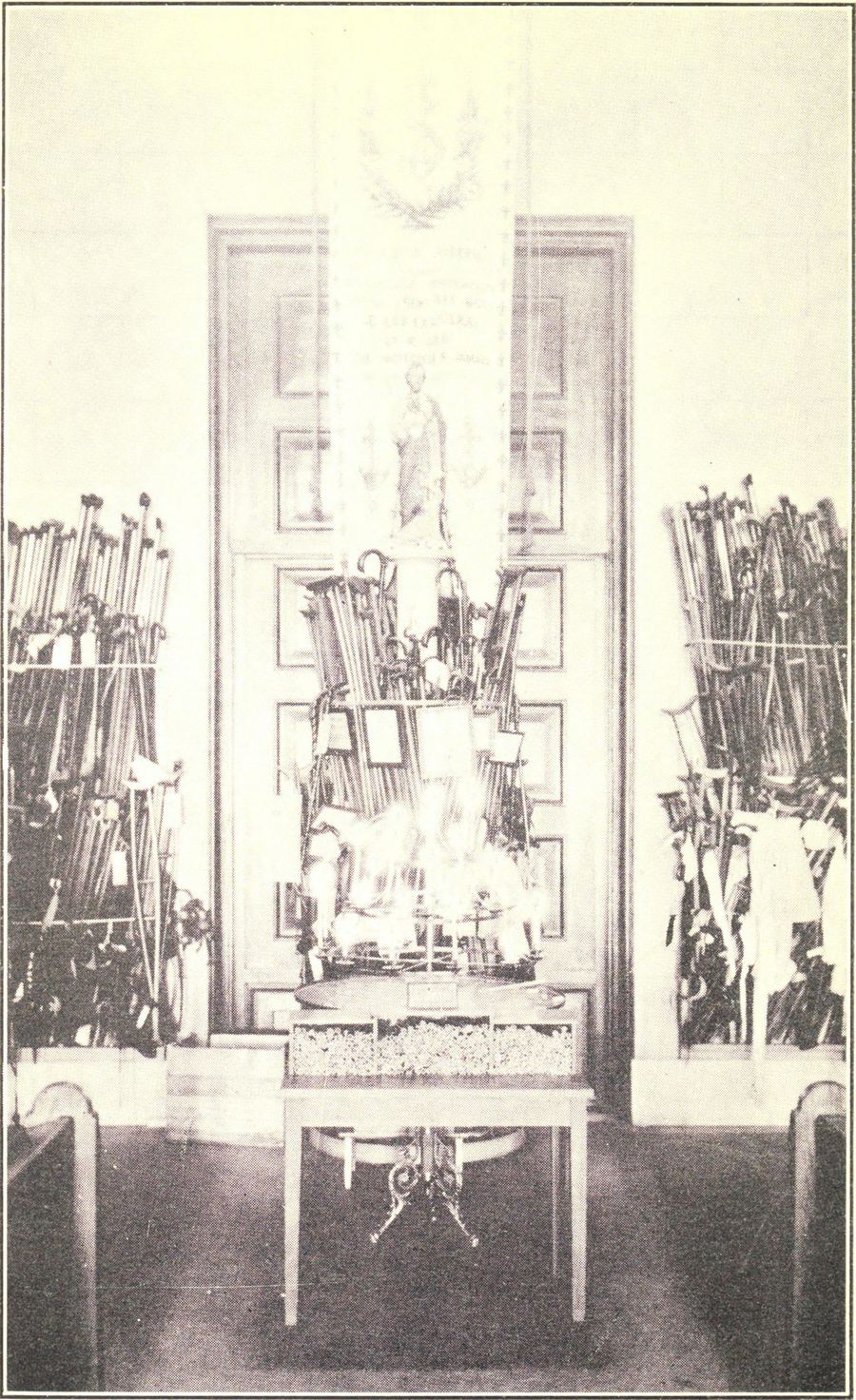
They began in the little chapel Brother André built on the mountain, where the ex-votos “were offered as a sign of gratitude by individuals whose prayers were answered.”13 By 1910 they stood there in pyramids. Blessing an extension of the chapel that November, the Archbishop of Montreal, Paul Bruchési, pointed to them: “Shall I say that miracles are wrought here? If I denied that such were the case, the ex-votive offerings in yonder pyramids would belie my words. I need make no investigation, I am convinced that extraordinary occurrences have taken place here.”10
A boy cured that year walked away leaving his crutches, “where they joined a constantly growing collection.”10 When André lay in state in the crypt church in January 1937, hundreds of crutches and canes were piled against the walls around his coffin.7,8
The scale of it is hard to take in. The Oratory received some ten million letters between 1910 and 1962, and more than fifteen thousand healings were reported to it in 1928 alone.3 André himself received two or three hundred letters a day, too many for one man, and a secretariat was set up to answer them.2 When André died in January 1937, more than a million people came to the Oratory to pay their respects.2,5
Part 2
The healings
In 1910 Martin Hannon, a railway employee, came to the Oratory on crutches. Heavy marble blocks had fallen on him and crushed his legs and feet. Brother André “rubbed his mangled limbs with holy oil and prayed over him,” and told him to throw his crutches away. The next day Hannon walked into the offices of the Montreal paper La Patrie to tell them so. It was, writes George Ham, “the first major miracle that brought him wider celebrity.”10,14
That same year Joseph L’Heureux, fifteen, came from Quebec with a diseased hip, after a novena to St. Joseph. “I had a talk with him,” he wrote. “At that same instant I allowed my crutches to drop.” His father placed a notice of thanks in the Quebec papers.10 Arthur Rochette, a railway brakeman from Richmond, was given a medal of St. Joseph and some of the oil, and dressed his injury with it at home; in 1921 he came back to give thanks.10
André did not always use the oil. Sometimes he prayed, sometimes he touched the injured place, sometimes he sent only a medal; often he gave all three. The cases below set out what was used, as the sources record it.
The record
Healings, and how they were reported
Most were first reported in the newspapers or in the Oratory’s Annales, and collected in George H. Ham’s The Miracle Man of Montreal (1922).10
| Who, when | What happened | How | Reported by |
|---|---|---|---|
| Brother Aldéric and others, before 1878 | A fellow brother reported his own cure and several others, the first account ever published. | The oil | The Annales of the Association de Saint-Joseph (Paris, 1878)2,5 |
| Martin Hannon, railway employee, 1910 | Legs and feet crushed by falling marble; walked without crutches. | The oil, rubbed on by André, and prayer | La Patrie, as reprinted by Ham and quoted by Lachance10,14 |
| Joseph L’Heureux, 15, 1910 | A diseased hip; let his crutches drop while talking with André. | A novena, and André’s prayer | His father’s notice in the Quebec papers, and his own letter, reprinted by Ham10 |
| Marie-Antoinette Mercier, 1910 | An injured eye, healed after she applied a medal blessed at the Oratory each day. | A medal | L’Action sociale (Quebec) and her doctors’ certificates, reprinted by Ham10,14 |
| Arthur Rochette, brakeman, 1912 | An injury dressed with “applications of the holy oil” at home. | The oil and a medal, applied himself | Ham10 |
| Mme Joseph Marcoux, 1921 | Heart disease; recovered “at the very moment” her husband asked André’s prayers. She was then told to keep the oil and wear the medal. | André’s prayer; then the oil and a medal | Her husband’s letter in the Oratory’s Annales, with a doctor’s certificate, reprinted by Ham10 |
| Joseph Audino, 1958 | Cancer, after invoking Brother André. Confirmed by the Church for his beatification. | Prayer | The Oratory6 |
| A boy of nine, 1999 | Gravely injured when a car struck him on his bicycle. Family friends brought him oil, a medal and a prayer card from the Oratory, and the family prayed to André. Confirmed by the Church for his canonization. | Prayer, with the oil and a medal brought to him | The Archdiocese of Montreal15,4 |
Part 3
Brother André

Alfred Bessette was born on 9 August 1845 in the parish of Saint-Grégoire, Lower Canada, so frail that the curé baptized him conditionally the next day.2 His father, a woodworker, was killed by a falling tree in 1855; his mother died of tuberculosis in 1857, when Alfred was twelve. Poverty and poor health ended his schooling: he could sign his name and read print, and little more.2 From 1863 to 1867 he worked in the mills and on the farms of New England.2
On 22 November 1870 he presented himself at Collège Notre-Dame, a school of the Congregation of Holy Cross in Côte-des-Neiges, and in December took the habit and the name André.2,4 His superiors hesitated to admit him because of his health; his novice master’s view was that “if this young man becomes unable to work, he will at least be able to pray well.”2 He made his final vows on 2 February 1874.2,5
From his entry he was the college’s doorkeeper, a post he held until 1909. The Oratory gives his first duties as “doorkeeper, infirmarian, and lamp tender.”2,5 It was at the door that the sick began to find him.
He never took the credit. “‘It is not I who heals,’ he would say, in tears. ‘It is St Joseph.’”2 And to those whose trials did not lift, he gave the counsel Benedict XVI quoted at his canonization: “Do not try to have your trials taken away from you, … rather, ask for the grace to endure them well.”1
He died on 6 January 1937, at ninety-one, in a hospital in Ville Saint-Laurent. His body lay in state at the Oratory until 12 January, and more than a million people came to pay their respects.2,5
Part 4
The lamp in the college chapel
Visitors to the college asked the doorkeeper to pray for them; some asked him to visit them at home. He prayed with them, and gave them “a medal of St Joseph … as well as a few drops of the olive oil that was burning before the saint’s statue in the school chapel, advising them to rub it on themselves confidently.”2 The Oratory says he was “inspired by a devotion that was already practiced in France.”11
The first known account of the cures appeared in Paris in 1878, in the Annales of the Association de Saint-Joseph, written by a fellow brother, Brother Aldéric (Désiré-Michel Giraudeau), who reported his own cure and several others.2
The crowds brought trouble. “Parents, colleagues, and even the school physician complained to the town’s religious and health authorities about the presence of sick people so close to the students. Some called Brother André a charlatan, a mere anointer.”2 His work “scandalized many priests, physicians and sophisticated Catholics.”16 Around 1900 he was asked to receive the sick in a shelter across the road, at the streetcar stop.2 The canonization decree says of these years that the hostility and disapproval he met made his apostolate richer and more fruitful.4
His superiors showed “a great deal of reluctance” towards his plan for a shrine on Mount Royal, and were won over by a man “who based his cause, not on any claim to miracles or visions, but only on his veneration for St Joseph.” When permission came to build the chapel, they and Archbishop Paul Bruchési of Montreal stipulated that any expenses were to be borne by those seeking help.2 On 5 May 1910 the archbishop allowed services to be held in the chapel, and appointed a committee of priests to look into the cures. It was given “many certificates signed by prominent physicians, both Protestant and Catholic, and 170 letters from persons who had been materially aided or cured.” Without pronouncing on the miracles themselves, it declared the devotion “in every way conformable” to what the Church required, and said the faithful might continue to come and seek St. Joseph’s intercession.10 That February, Pope Pius X had sent the Oratory his Apostolic Benediction.10 A commission of inquiry set up by the archbishop held a hearing at the college on 28 November, and his approval, says the Oratory, gave the work its impetus.17
Part 5
What the Church confirmed
The Church declared Brother André’s virtues heroic in 1978, beatified him on 23 May 1982, and canonized him on 17 October 2010.5,4 Each of the last two steps required a miracle at his intercession, examined by a medical commission, and for canonization by theologians and cardinals as well.6,4
For beatification, 1982
By canonizing, the Church solemnly proclaims that a person “practiced heroic virtue and lived in fidelity to God’s grace,” and proposes them to the faithful “as models and intercessors.”18 Its formal judgment on healings rests on these two; the thousands of others are the testimony of the people who came.
His heart, kept at the Oratory, was found stolen on 16 March 1973 and recovered on 21 December 1974; the Oratory refused the ransom, and the thieves were never found.19
Part 6
From chapel to basilica
The college bought land on Mount Royal in 1896. On it, with a few friends, Brother André built a small chapel to St. Joseph, the oratory from which the basilica takes its name.2,20
Timeline
Saint Joseph’s Oratory of Mount Royal
Dates from the Oratory’s own history, unless noted.20
- 1896Collège Notre-Dame buys the land on the mountain.2
- Oct. 1904The first chapel opens: blessed on 19 October, says the Oratory; inaugurated on 16 October, says the Dictionary of Canadian Biography.20,2
- 1908–1912The chapel is enlarged four times to hold the crowds.20,2
- 1909André’s years as the college’s doorkeeper end, in July.2
- 1910The archbishop’s commission of inquiry holds a hearing, 28 November.17
- 1917The crypt church, seating a thousand, is inaugurated on 16 December.2
- 1924The basilica’s cornerstone is blessed before some 35,000 people.
- 1931–1937Work stops in the Depression, and resumes the year André dies.
- 1955The Oratory is made a minor basilica, 19 March.
- 1956The basilica officially opens; its interior is completed in 1967.
- 2004The basilica is consecrated, 17 October.
Part 7
The oil today, and using it
The oil comes from the basin in the Votive Chapel: “A basin of vegetable oil placed in front of a statue of Saint Joseph contains a flame that burns day and night. This oil is bottled.”11 In André’s years at the college it was olive oil from the lamp in the chapel; the Oratory calls today’s oil the same tradition, continued.2,11
The Oratory gives one instruction, and it is Brother André’s: he recommended that the sick “rub the afflicted part of their body with this oil and pray to Saint Joseph.”9 There is no set prayer; as CatholicCulture.org puts it, describing the Oratory’s practice, “each one can pray in his own way or use a prayer he or she likes.”21 For prayers to St. Joseph, see the Novena to Saint Joseph.
- Have it blessed.Oil sent by mail is blessed by a priest of the Oratory before shipping; oil bought in person is not blessed as sold, and any priest may bless it.12,22
- Anoint the place that hurts,as André advised, and ask St. Joseph’s intercession.9
- Pray with faith.“It is not the oil itself which cures,” says the Oratory, “but the Lord who hears the prayer of the faithful.”23
- Keep the doctor too.The Oratory calls the oil an act of faith, not a remedy.11
- Ask for the sacramentwhen someone is in danger from serious illness: the Anointing of the Sick is given by a priest.24
Part 8
Oil, blessing and sacrament
The Church uses oil in its sacraments. Three holy oils are ordinarily blessed by the bishop once a year at the Chrism Mass, on Holy Thursday or a day near it: the sacred chrism, the oil of catechumens and the oil of the sick.25 St. Joseph’s oil stands beside them as something different: not a sacrament, but a sign used in prayer.
Side by side
The holy oils and St. Joseph’s oil
| Oil | Blessed by | Used for |
|---|---|---|
| Sacred chrism | The bishop, at the Chrism Mass | Anointing the newly baptized and signing those being confirmed25 |
| Oil of catechumens | The bishop, at the Chrism Mass | Preparing catechumens for Baptism25 |
| Oil of the sick | The bishop, at the Chrism Mass (a priest may bless it in an emergency, during the sacrament)26 | The sacrament of the Anointing of the Sick, given by a priest25,24 |
| St. Joseph’s oil | An Oratory priest, before shipping; or any priest12,22 | Private prayer for healing, as an act of faith11 |
The Anointing of the Sick is given only by priests.24,26 A mother rubbing St. Joseph’s oil on a feverish child is doing something else: praying, with a sign, to St. Joseph. The blessing of the oil is a sacramental, a sacred sign that “by the Church’s prayer” prepares people to receive grace.27 The old Roman Ritual has a blessing for ordinary oil, the Benedictio olei simplicis, which any priest may give, asking that it be, for all who use it, “salus mentis et corporis,” health of mind and body.28,22
The Church’s one caution is the same for every sacred sign: it is not to be credited with power by its mere performance, “apart from the interior dispositions that they demand.”29 The Oratory puts it in its own words: the oil is “not a remedy, much less a magical rite. It must first be seen as an act of faith.”11
Part 9
An older custom
Brother André drew on a devotion already practised in France,11 and behind it lies a far older one. By the time of St. Paulinus of Nola, who died in 431, oil was poured over martyrs’ relics, collected, and given out “as a remedy against sickness,” not “through any intrinsic power of their own, but through the intercession of the saints.”30 Oil from the lamps before famous tombs was “daily distributed to pilgrims, who venerated it as a relic.”31 Pope Gregory the Great sent Queen Theodolinda ampullae of oil from the tombs of the Roman martyrs, and several survive in the cathedral at Monza.32
St. Joseph’s oil belongs to that family, with one difference: it burns before a statue, not a tomb.11 Oils that have touched a saint’s body or grave are counted as relics;33 this one draws its meaning from the prayer that goes with it, and from the Church’s blessing.
Sources
Quotations from the Oratory are from its own English pages. The Catholic Encyclopedia (1907–1912), the 1903 Roman Ritual and George H. Ham’s 1922 book are in the public domain. Church documents and modern works are cited with brief quotations only.
- Benedict XVI, Homily for the canonization of six new saints, 17 October 2010. www.vatican.va
- Denise Robillard, “Bessette, Alfred, named Brother André,” Dictionary of Canadian Biography, vol. 16 (2005, rev. 2016). French text: “Bessette, Alfred, dit frère André.” www.biographi.ca
- Tom Sinclair-Faulkner, “Sacramental Suffering: Brother André's Spirituality,” CCHA Study Sessions 49 (1982), 111–134. cchahistory.ca
- Benedict XVI, Litterae decretales for the canonization of André Bessette, 17 October 2010 (Latin). www.vatican.va
- Saint Joseph's Oratory, “Encountering Saint Brother André” (timeline); French version “À la rencontre de saint frère André.” saint-joseph.org
- Saint Joseph's Oratory, “How Alfred Bessette Became Saint Brother André.” saint-joseph.org
- Eric Reguly, “Brother André: The Rocket Richard of miracles,” The Globe and Mail, 15 October 2010. www.theglobeandmail.com
- The Catholic Register, “The Register Archives: Br. André's healing miracles continue after death” (15 October 2018). www.catholicregister.org
- Saint Joseph's Oratory, “The Votive Chapel.” saint-joseph.org
- George H. Ham, The Miracle Man of Montreal (Toronto, 1922). Public domain. An admiring account that largely reprints the Oratory's own Annales. archive.org
- Saint Joseph's Oratory, “Spirituality: Saint Joseph Oil.” saint-joseph.org
- Saint Joseph's Oratory gift shop, “Service” (frequently asked questions). boutique.saint-joseph.org
- Saint Joseph's Oratory, “The Original Chapel.” saint-joseph.org
- Micheline Lachance, Le frère André (1979; Éditions de l'Homme, 2010), as excerpted on Wikiquote. A journalist's biography with reconstructed dialogue; cited here only where it quotes a newspaper. fr.wikiquote.org
- Archdiocese of Montreal, “Le miracle qui a mené à la canonisation du frère André.” www.diocesemontreal.org
- Tom Faulkner, “Saint André,” The Canadian Encyclopedia (2011, ed. 2015). thecanadianencyclopedia.ca
- Saint Joseph's Oratory, “International Recognition,” citing the cause's Summarium (1955). saint-joseph.org
- Catechism of the Catholic Church (CCC) 828. www.vatican.va
- Radio-Canada, “Le cœur du frère André, un vol qui a fait jaser” (archives, 2019, updated 2023). ici.radio-canada.ca
- Saint Joseph's Oratory, “The History of Saint Joseph's Oratory” (timeline). saint-joseph.org
- CatholicCulture.org, “Saint Joseph's Oil” (undated; relays the Oratory's guidance). www.catholicculture.org
- Code of Canon Law, can. 1166–1172 (sacramentals). www.vatican.va
- Saint Joseph's Oratory gift shop, description of Saint Joseph oil. boutique.saint-joseph.org
- CCC 1514–1516. www.vatican.va
- USCCB, “The Blessing of the Oils and the Consecration of the Chrism,” citing the Order of Blessing the Oils. www.usccb.org
- Code of Canon Law, can. 998–1007 (Anointing of the Sick). www.vatican.va
- CCC 1667–1676. www.vatican.va
- Rituale Romanum (Regensburg: Pustet, 1903), Title VIII, chapter 19, “Benedictio olei simplicis,” p. 234. Public domain. archive.org
- CCC 2111. www.vatican.va
- Catholic Encyclopedia (1911), “Oil of Saints.” www.newadvent.org
- Catholic Encyclopedia (1910), “Holy Oils.” www.newadvent.org
- Catholic Encyclopedia (1907), “Ampullæ.” www.newadvent.org
- Directory on Popular Piety and the Liturgy (2001), nos. 11 and 236. www.vatican.va